

Huntsman Spider Care
A huntsman spider can cross a tub, wall, or hand faster than most keepers expect. That speed is the first thing to respect. These spiders are fascinating, alert, and often visible in the enclosure, but they are not calm lap pets and they do not reward casual handling.
This guide covers the core care points for commonly kept huntsman spiders, including temperature, humidity, feeding, enclosure setup, safety, and how to catch or move one without panic. Species differ, so use this as a practical baseline and adjust for the exact species you keep.

Know what huntsman spiders are like before keeping one
Huntsman spiders are members of the family Sparassidae. Many have flattened bodies, long laterigrade legs, and a habit of tucking themselves against bark, rock, or glass. They are often called “giant crab spiders” because of the way their legs splay sideways.
In captivity, the main care challenge is not complex feeding or rare equipment. The challenge is speed and containment.
A huntsman may sit still for hours, then burst into motion the moment the lid opens. Some will sprint upwards. Some will leap short distances. Others will flatten into a tight gap and refuse to move. A secure enclosure and calm maintenance routine matter more than frequent interaction.
A well-kept huntsman usually needs:
A warm, stable temperature range
Moderate humidity with good air flow
Vertical hides and climbing surfaces
A secure, escape-proof enclosure
Appropriately sized live prey
Minimal handling
Careful planning before any move
Temperature and humidity should stay stable
Most commonly kept huntsman spiders do well in a warm room, provided temperatures do not swing too sharply. Many tropical and subtropical species are comfortable around 22 to 28°C. A slight drop at night is usually fine.
Avoid placing the enclosure on a windowsill, above a radiator, or in direct sun. Glass can heat quickly, and overheating can kill a spider far faster than a cooler room would.
If extra heat is needed, use gentle background heat rather than something intense inside the enclosure. A heat mat on the side of the enclosure can work, but it should be controlled with a thermostat and should not cover the whole wall. The spider must be able to move away from warmth.
Care point | Practical range | Notes |
Day temperature | 22 to 28°C | Keep stable and avoid direct sun |
Night temperature | 18 to 22°C | Brief mild drops are usually tolerated |
Humidity | 60 to 75% for many species | Adjust for species and ventilation |
Ventilation | Moderate to high | Stale, wet air is a bigger risk than brief dryness |
Humidity needs depend on the species. A tropical huntsman will need more moisture than a species from a drier habitat. As a general rule, offer moderate humidity without making the enclosure wet.
Good humidity care looks like this:
Lightly mist part of the enclosure, not the whole tank
Let the substrate partly dry between mistings
Keep a small water dish available if the enclosure size allows it
Watch for mould, condensation, and stale air
Increase ventilation if the enclosure smells damp
Condensation on every wall is a warning sign. Damp, stagnant air encourages mould and can stress the spider. A slightly moist corner and dry retreat options are safer than a constantly wet enclosure.

The enclosure must handle speed and climbing
A huntsman enclosure should be built for a fast, flat-bodied climber. Width and height both matter, but height and vertical surfaces are especially useful for many species.
For a medium adult huntsman, a practical enclosure might measure around 30 cm tall, 30 cm wide, and 30 cm deep. Larger species need more room. Juveniles can live in smaller containers, but the enclosure still needs excellent security and ventilation.
The lid is the most important part. A huntsman can push through weak gaps, squeeze behind décor, or dash out during feeding. Use a firm-fitting lid with small ventilation holes. Check that no gap is wider than the spider’s carapace.
Set up the enclosure with usable cover
Huntsman spiders like surfaces they can grip and hide behind. A bare plastic box may keep one alive, but it will not allow natural retreat behaviour.
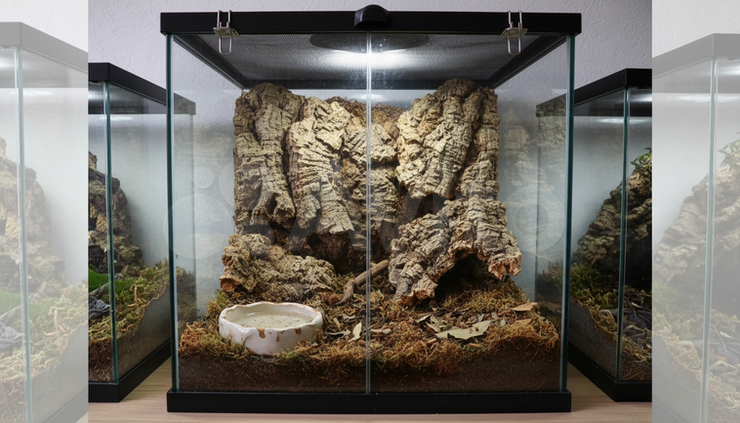
A good setup includes:
Vertical cork bark
Curved bark tubes or slabs
Rough climbing surfaces
A shallow substrate layer
Leaf litter or moss in one area
Secure ventilation on the sides or lid
A small water dish for larger enclosures
Do not overload the enclosure with loose decorations that can shift. If bark falls while the spider is moulting, it can injure or kill it. Press cork pieces firmly into the substrate or wedge them securely.
Substrate does not need to be deep for most huntsman spiders. A few centimetres of coco fibre, chemical-free topsoil, or a suitable arachnid substrate can help hold humidity. Keep it clean and remove prey remains promptly.
Choose the right door style
Front-opening enclosures can be easier to work in because the spider usually runs upwards or sideways rather than straight out of a lifted lid. Top-opening tubs can work, but they give a fast spider a clear escape route.
If using a top-opening container, open only a small section at a time. For larger or nervous huntsman spiders, work inside a larger catch bin as a safety layer.
The best enclosure is not the prettiest one. It is the one that lets the spider behave normally while preventing escapes during ordinary care.
Feeding should be simple, measured, and tidy
Huntsman spiders are active predators, but they do not need constant feeding. Overfeeding can create an obese spider, foul the enclosure, and leave uneaten prey that may harm the spider during a moult.
Feed prey that is no larger than the spider’s body length, not including the legs. Suitable feeders often include:
Crickets
Locusts
Dubia roaches
Small cockroaches from clean feeder colonies
Occasional mealworms or waxworms, used sparingly
A typical adult may eat once every 7 to 10 days, though appetite varies. Juveniles may feed more often because they are growing. A spider nearing a moult may refuse food for days or weeks. Do not force the issue.
Remove uneaten prey after a few hours, especially crickets. Crickets can bite a resting or moulting spider. This is one of the most common preventable risks in arachnid keeping.
Read the spider’s condition
A well-fed huntsman has a rounded abdomen, but it should not look swollen to the point of dragging or tightness. A thin abdomen can mean the spider needs food or moisture, though it can also happen after egg laying or stress.
Signs that feeding is on track include:
Strong prey response when hungry
Regular but not excessive growth in juveniles
A full abdomen after meals
Normal resting posture and grip
Clean retreats without rotting prey parts
If the spider refuses food but stays plump and alert, give it time. If it becomes weak, shrivelled, or unable to climb, review humidity, hydration, temperature, and stress.

Safety starts with not handling them
Huntsman spiders are not usually considered dangerously venomous to healthy adults, but a bite can still hurt. Reactions vary. Pain, swelling, nausea, or allergic reactions are possible with many spider bites. Seek medical advice if symptoms are severe, unusual, or worsening.
The better safety rule is simple: do not handle a huntsman unless there is a genuine reason.
Handling creates risk for both the spider and the keeper. A fall from even a modest height can injure a spider’s abdomen. A startled spider may bolt, jump, or bite if trapped against skin.
Use tools instead:
Long soft paintbrush
Catch cup
Clear plastic tub
Feeding tongs
Card or thin plastic sheet
Larger tray or bin for transfers
Avoid blowing on the spider. A sudden air blast can trigger a sprint. Avoid poking the abdomen. Use gentle guidance near the rear legs or side, and give the spider somewhere obvious to move.
Respect their speed
Huntsman spiders are famous for explosive movement. They can go from still to sprinting in less than a second. This does not mean they are aggressive. It means they rely on speed to survive.
Before opening the enclosure, prepare the area:
Close windows and doors
Block gaps under doors if needed
Clear clutter from the work surface
Put pets and children in another room
Have a catch cup ready
Move slowly and avoid sudden shadows
If the spider bolts, pause. Chasing wildly often makes things worse. Watch where it goes, then use a cup and card once it stops.
A calm keeper loses fewer spiders.
Catching and moving a huntsman without panic
Moving a huntsman is easiest when you set up layers of control. Do not open the enclosure first and then look for tools. Prepare everything before the spider has any route out.
You will need:
A clear catch cup or tub
A stiff card or thin plastic sheet
A soft brush
The new enclosure, fully prepared
A larger empty storage box if the spider is very fast
Good lighting
For nervous or very quick spiders, place the entire old enclosure inside a larger plastic storage box. This gives you a second boundary if the spider runs.
Use the cup and card method
The cup and card method works for many huntsman transfers, but it must be done slowly.
Open the enclosure only as much as needed
A small opening gives you more control than a fully removed lid.
Guide the spider onto an open surface
Use a soft brush, not your fingers. Gentle pressure is enough.
Place the cup over the spider
Move steadily. Do not slam the cup down, as legs can be trapped.
Slide the card underneath
Keep the card flat against the surface so the spider cannot squeeze out.
Move the spider to the new enclosure
Keep the cup upright and close to the destination.
Release near cover
Let the spider walk out beside cork bark or a retreat. Do not shake it out.
If the spider clings to the inside of the cup, place the cup in the new enclosure and wait. It will usually leave when it feels secure.
Move the hide instead when possible
One of the safest ways to move a huntsman is to move the object it is already sitting on. If the spider rests on a removable cork slab, lift the whole slab and transfer it into the new enclosure.
This reduces chasing and lowers bite risk. It also helps the spider settle because it keeps a familiar surface.
Only do this if the cork can be lifted securely. If the spider is on loose or awkward décor, use the cup method.
Moulting care needs quiet and space
Moulting is a vulnerable time. A huntsman may stop eating, become duller in colour, hide more, or sit in one spot for long periods. Do not disturb it.
During pre-moult and moult:
Remove all live prey
Keep humidity steady
Avoid major enclosure changes
Do not touch or move the spider
Keep vibration low
Wait before feeding again
After moulting, the spider’s new exoskeleton needs time to harden. Juveniles may be ready to eat sooner than adults, but waiting several days is safer for larger spiders. Feeding too soon can lead to injury if prey fights back.
Leave the moult in place for a short time if removing it would disturb the spider. Once the spider has moved away and hardened, you can take it out with tongs.
Common mistakes to avoid
Most huntsman care problems come from a few avoidable mistakes.
Using an enclosure with gaps
A flat spider can escape through spaces that look too small. Check lid edges, cable holes, vents, and door seams.
Keeping the enclosure too wet
Humidity matters, but stagnant damp air is unsafe. Balance moisture with ventilation.
Leaving crickets inside overnight
A hungry cricket can injure a spider, especially during a moult.
Handling for fun
Even a calm huntsman can bolt. Handling adds risk and gives little benefit.
Working without a catch cup nearby
A catch cup should be within reach before every feeding, misting, or clean.
Reacting too fast when the spider runs
Sudden grabs and panicked movements can injure the spider and increase the chance of a bite. Stop, watch, then contain.
A simple weekly care routine
A consistent routine keeps care easy and reduces stress.
Several times a week, check:
Temperature and humidity
Water availability
Signs of mould
Whether the spider is active and gripping well
Any uneaten prey or prey remains
Once a week, feed if the spider is hungry and not in pre-moult. Remove remains the next day. Wipe dirty glass only where needed, and avoid tearing the enclosure apart unless there is a hygiene problem.
Every few months, refresh part of the substrate if needed. Do not fully rebuild the enclosure unless it is dirty, unsafe, or too small. Huntsman spiders settle better when their retreats stay familiar.
The safest care is calm, prepared care
A huntsman spider is rewarding to keep because it behaves like a true ambush predator. It rests flat against bark, reacts quickly to prey, and uses space in a way that makes a well-built enclosure worth the effort.
The key is respect. Keep temperatures warm and stable, humidity moderate, and ventilation strong. Feed measured prey, remove leftovers, and treat every enclosure opening as a planned event. Most of all, remember that speed is normal, not a problem to train away.
If you prepare before you open the lid, use tools instead of hands, and give the spider secure places to hide, huntsman care becomes calm, safe, and surprisingly straightforward.


Comments