
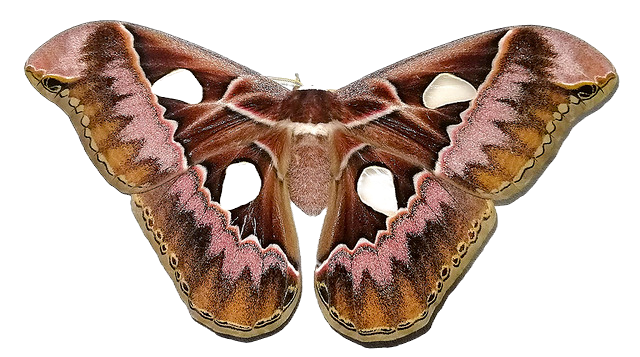

A striking Central American saturniid with bold patterning and impressive wingspan.
Rothschildia inca is one of the most visually dramatic members of the Rothschildia genus, native to Mexico and parts of Central America. Adults display the classic saturniid “windowed” wings, with large hyaline patches framed by deep maroon, chestnut, or chocolate‑brown banding. The forewings are sharply angled, giving the species a distinctive geometric look compared to R. lebeau or R. jacobaeae.
Adults are large—typically 12–15 cm wingspan—and short‑lived, flying for only a week or two. They do not feed, relying entirely on stored larval reserves. Males are slimmer with more feathery antennae; females are heavier-bodied and slower in flight.
Larvae are equally impressive: pale green with contrasting white tubercles and a neat, orderly appearance. They feed readily on Ailanthus, Ligustrum, Prunus, Salix, and Ricinus, making them straightforward to rear in captivity. Pupation occurs in a tough, papery cocoon, often attached to twigs or enclosure mesh.
This species is less commonly offered than R. lebeau or R. aurota, and availability in Europe fluctuates depending on seasonal breeding cycles.
Inca Atlas Moth Cocoon (Rothschildia inca)
Specifications
Size: Cocoon (pupae)
Status: Captive Bred
Range: Mexico and Central AmericaCare information
Temperature 22-26 C Humidity 55-65% (Cocoons)
50-60% (Adults)
Diet Adults do not feed Enclosure as adults 60x60x60cm for adult pair Important Info
Although pupae will be checked prior to sending to ensure they are live and healthy we cannot always guarantee they will hatch. This is dependant on temperatures and humidity